A home in every region
Place exactly one cat in each colored region. Once that cat is settled, the other squares in its region are no longer candidates.
 mewdokuthe puzzle companion
An independent Meowdoku guide
There’s a good reason for every cat’s favourite spot. Learn how to find it, one satisfying move at a time.
Your visual companion to Meowdoku strategy, hints and those tricky little corners.
Napdoku · A related Android cat puzzle
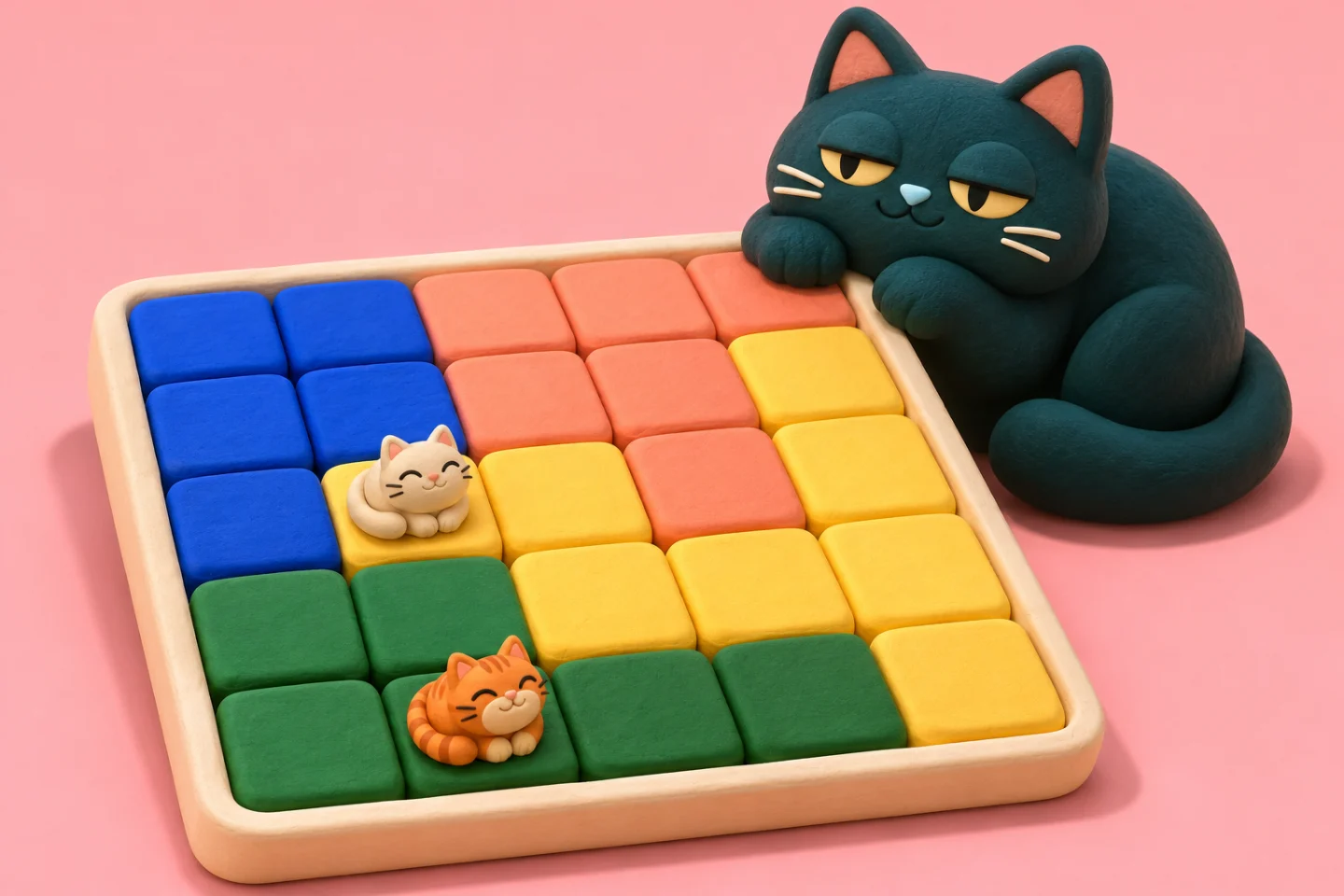
Meowdoku turns a few simple placement rules into a cat logic puzzle. Colored regions divide the board, and every cat you place changes what remains possible elsewhere.
The useful question is “What can I rule out?” A line that already contains a cat, an occupied region, or a neighboring corner can eliminate a tempting square. Once you’ve ruled out the other candidates, the remaining spot has to be right.
Run these checks together. A square needs to pass all three before it can hold a cat.
Place exactly one cat in each colored region. Once that cat is settled, the other squares in its region are no longer candidates.
Two cats cannot share a row or column. Follow each line to the edge of the board, including the parts that cross into another region.
Cats cannot touch diagonally. The four squares at a cat’s corners are blocked, alongside the rest of its row and column.
Meowdoku hints, explained
A placement gives you more information than its own square. The example marks every row, column and corner conflict created by the cat in the middle.
Now imagine a region whose last two candidates include one of these marked squares. Eliminate that square and the region has just one legal home left.
The cat’s row, column and four neighboring corners are marked.
Meowdoku tips and tricks
A larger board asks for more bookkeeping. Keep the candidates visible and look for a connection between a region and a line.
A Meowdoku walkthrough is easiest to follow when every move comes with a reason. Try this sequence on your next board.
Scan the regions and any cats already on the board. Mark their conflicts before judging how many choices another region has.
For each candidate you remove, name the rule it breaks. If you cannot eliminate all but one square in a region, keep looking for a line deduction.
A new cat settles its region and rules out its row, column and neighboring corners. Finish that sweep so the next decision uses the current board.
A quick reset
A cat’s row and column continue across every region. It is easy to stop checking at the edge of a colored patch.
Two cats can be in different rows and columns and still touch at a corner. Keep the diagonal test as its own final check.
If nothing seems possible, retrace the last few exclusions. A reliable mark should follow from a placed cat or a definite region-and-line deduction.
Mewdoku is the name of this independent guide. The game discussed here is Meowdoku, published by Oakever Games. You can view the original Meowdoku listing on Google Play.
The diagram explains exclusions from a single cat. Use the strategies to work through your own board. This guide does not calculate a full solution from a screenshot.
Start with the least flexible region, then look for candidates confined to one line. Those clues explain a move and help with the rest of the board. This page focuses on a reusable method rather than answers to numbered levels.
Double-tap a square in Meowdoku. Check the placement first because an incorrect square costs a heart.
The row-and-column reasoning feels familiar if you enjoy sudoku. Meowdoku adds colored regions and diagonal spacing, and asks you to place cats instead of completing a number grid.
The clay scenes are original illustrations. The marked diagram is a teaching example for the placement rules and does not reproduce a specific level.